The AI Loan Officer Exists. The Hard Part Is Everything Around It.
AI loan decisions are lifecycles, not responses: async intake, queued workers, human-review loops, and an audit trail regulators can trust - end to end.

An AI decision is not a request-response: it is a lifecycle. Accept the request and return an ID instantly, process through a queue with autoscaled workers, route every verdict through a state machine - including human-review and query loops that re-enter the pipeline - and keep an immutable, versioned audit trail so any past decision can be defended.
Right now, in a thousand companies, the same architecture is being drawn on a whiteboard. User hits an endpoint, endpoint calls the model, model returns the answer. Request in, intelligence out. It is how we have wired software for thirty years, so it is how everyone is wiring AI.
For a chatbot, fine. But the AI systems banks actually want, the ones that decide things, do not behave like responses. The concrete case this post is built on is an AI loan officer: a lending model that reads an application and returns Approved, Denied, Mismatch, or Query.
Three facts break the request-response picture at once. The verdict takes about 8 minutes, and nothing in the web stack will hold a connection that long. Two of the four verdicts are not answers at all: they are detours through a human that come back. And in a regulated business, the decision is not finished when it is delivered. You must be able to defend it, with the exact model that made it, years later.
A response is a moment. A decision is a lifecycle. It starts before the model runs and stays alive long after. Architect for the moment and you get a demo. Architect for the lifecycle and you get a production system. Here is the lifecycle version, end to end: four moves I think of as the lifecycle four, and the design I would defend in a review.
The engineering problem: one slow model, hundreds of decisions a day
The constraint takes one line. Inference runs about 8 minutes. The callers operate on connection timescales of seconds: a finance team uploading batches of 300, customer apps trickling in singles. Nobody needs the verdict instantly. They need the system to take the request instantly and never lose one.
So the engineering problem is not “make the model faster”. It is this: turn one slow model into a decisioning system that absorbs any load, scales out, survives failures, and can prove every verdict. That is a known pattern, and it starts with one rule:
Never make the caller wait. Accept the request, return an ID in milliseconds, process in the background, notify when the verdict lands.
Everything else in this design is a consequence of that one rule. Drawn out, the whole system looks like this:
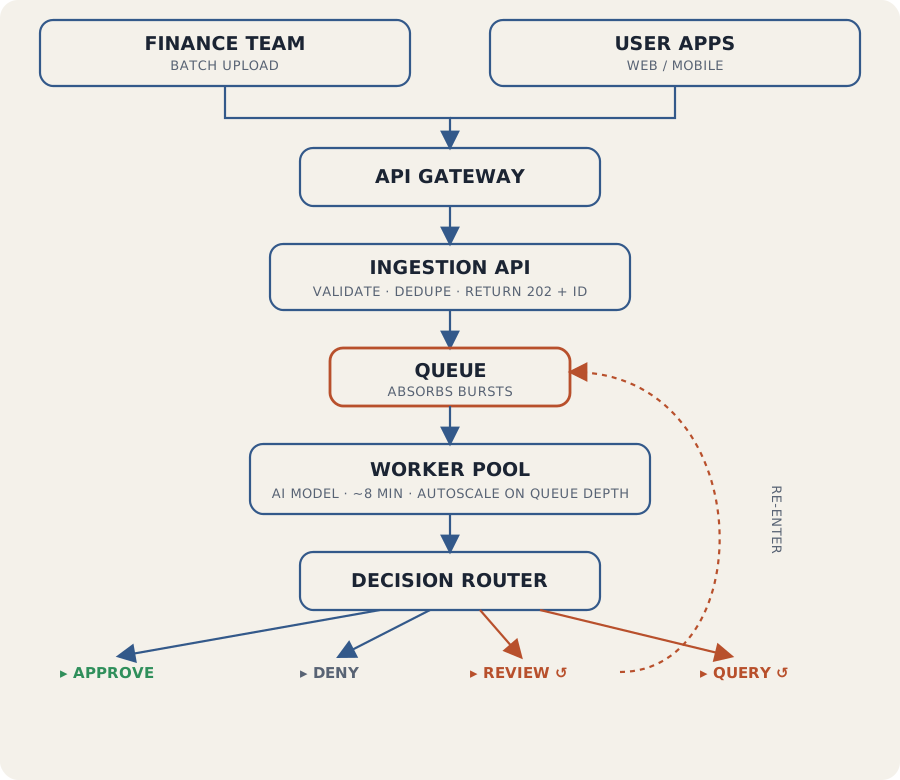
Requests enter once. Verdicts leave four ways, and two of those ways loop back in. The sections below walk it left to right.
Walking the flow: from loan application to AI verdict
Two kinds of traffic, one front door
The finance team sends bulk uploads: bursty, hundreds at once, nobody watching a spinner. The customer apps send single applications in a steady trickle. The person on the other end cares about the acknowledgement, not the verdict. Different shapes, same door. One gateway handles auth, validation and rate limiting, so no downstream service reinvents them. The interesting part is what happens in the milliseconds after that door.
The accept-fast layer
The ingestion API is where the async promise is kept. For every request it validates the payload. Then it deduplicates on an idempotency key, because a retried upload must never create two loan decisions. It parks the documents in object storage, writes status = RECEIVED to the state DB, and pushes a message onto the queue. Then it returns 202 Accepted with an application_id. Total connection time: milliseconds. The caller polls or gets a callback later.
That idempotency key is not a nice-to-have. Finance teams re-upload files. Mobile apps retry on flaky networks. Without dedup, “the model approved this loan twice” becomes a sentence you say to an auditor.
The queue is the shock absorber
The queue is the least glamorous and most important box in the diagram. It converts unpredictable inbound load into a steady, controllable workload. A burst of 1,000 requests does not crash anything. The queue just gets deeper, and workers drain it at their own pace. If you remember one component from this article, make it this one.
Workers: your existing AI app, multiplied
Each worker pulls one message, runs the model for about 8 minutes, and writes the verdict back. Three properties are non-negotiable. Workers are stateless and containerised, so N copies run happily. They autoscale on queue depth, not CPU, because queue depth is the only metric that measures actual backlog. And they are idempotent: a worker dying mid-run just means the message reappears and another worker finishes the job.
How do you scale a slow AI model? The capacity maths
One worker does 60 / 8 = 7.5 requests an hour, about 180 a day around the clock. You never make a single request faster. You run more of them in parallel, and throughput scales linearly:
- Workers needed =
(daily volume x 8 min) / available minutes - At 500 requests/day, running 24x7:
500 x 8 / 1440 = about 3 workersas the baseline. Autoscale to about 10 for bursts, and toward zero overnight so you stop paying.
For a bank, that last property is the quiet headline. The marginal cost of a decision is a few worker-minutes of compute, and idle hours cost nothing. The full queueing maths, from Little’s Law to burst sizing, deserves its own post, and it is coming in this series.
It is not a pipeline. It is a decisioning engine.
This is the part most write-ups skip. The four verdicts are not four labels. They route differently, and two of them are loops, not endings:
| Verdict | What happens | Human in the loop? |
|---|---|---|
| Approved | Disbursement workflow + notify | No |
| Denied | Notify with reason code + audit | No |
| Mismatch | Route to an Ops review queue | Yes, and it loops |
| Query | Request missing info, then re-enter the pipeline | Yes, and it loops |
Mismatch and Query are not failures. They go to a human or back to the applicant, get corrected, and are re-enqueued. A request has a lifecycle:
RECEIVED -> QUEUED -> PROCESSING -> +-- APPROVED  -> DISBURSED
                                    +-- DENIED    -> CLOSED
                                    +-- MISMATCH  -> UNDER_REVIEW  -> (re-queue)
                                    +-- QUERY     -> AWAITING_INFO -> (re-queue)
A decision’s lifecycle: four exits, two of which come back.
Model this as a state machine from day one. Bolting states onto a boolean later is how systems rot.
There is also an agentic angle here, and it is where this series is heading. The Ops review step is a queue of structured judgements. That makes it a natural seat for a supervised agent. It drafts the review, cites the evidence, and hands the human a decision to approve rather than a case to research. The loops in this diagram are exactly where agentic behaviour earns its keep. Every loop has a defined state, a bounded task, and an audit trail already waiting.
Audit, explainability, compliance
A lending decision is a regulated act, and this is the section a bank’s leadership will read first. That is why it comes before the failure drills, not after. The audit trail is a first-class citizen of the architecture:
- Immutable, append-only record of every decision: reason codes, model version, timestamps.
- Explainability stored per verdict: which features drove it. Disputes and regulators will ask.
- Decision versioning: any historical call can be defended with the exact model that made it.
- PII encrypted at rest and in transit, with strict access control.
None of this is architecture garnish. For a lender it is the difference between an incident and a headline.
Security notes: the abuse cases to design for
Compliance answers the regulator. Security answers the attacker, and a decisioning system has a specific attack surface:
- The front door: authenticated callers only, rate limits per client, schema validation before anything touches storage. Reject early, log the rejection.
- The model as a target: inputs are untrusted documents. Malformed or adversarial files take the poison-request path: bounded retries, then the dead-letter queue, never a crash loop.
- Workers on least privilege: a worker can read its message, its documents, and write its verdict. It cannot touch another applicant’s data, and it cannot rewrite the audit store’s history.
- The audit trail as a crown jewel: append-only by permission, not by convention. If an attacker can edit history, the compliance story above is fiction.
What happens when a worker crashes mid-decision?
The failure drills, and what the design already does about them:
- Worker dies mid-run: the message’s visibility timeout expires, it returns to the queue, another worker retries. Idempotency prevents a double decision.
- Poison request that fails every time: retried N times with backoff, then parked in a dead-letter queue for a human. It never blocks the line.
- Traffic burst: the queue absorbs it, workers scale out, nothing is dropped.
The pattern in all three is the same. Failures are routed, never raised to the caller, and never allowed to stop the line.
Steal this: the design-review checklist. Five questions this architecture answers before anyone asks:
- Worker crashes? Queue redelivery + idempotency.
- Poison requests? Backoff, then dead-letter queue.
- Sudden bursts? Queue absorbs, workers autoscale.
- Cost? Scale-to-zero. You pay per processing minute.
- Defend a decision from two years ago? Immutable audit + model versioning + stored explanations.
FAQ: AI loan decisioning in practice
Will AI replace loan officers? Not in the systems I build. The model clears the unambiguous cases: clean approvals and clean denials. Mismatch and Query verdicts still route to a human, and the correction feeds back into the pipeline. The job shifts from reading every file to judging the edge cases.
What is AI loan decisioning? It is the full lifecycle around an AI lending verdict: intake, queueing, model inference, verdict routing, human review loops, notification, and an audit trail. The model is one box. The system is the other nine.
How is this different from AI underwriting? AI underwriting scores the risk on one application. AI loan decisioning is the production system wrapped around that scoring: idempotent intake, autoscaled workers, and verdict routing. Add the immutable trail that lets you defend any decision years later. You need both, and this article is about the second one.
Takeaway
The model was never the hard part. The mistake is architectural, and it is everywhere right now: treating an AI decision as a response when it is a lifecycle. Four moves make the shift, the lifecycle four. Decouple receiving from processing. Scale horizontally on queue depth. Treat every verdict as a state machine whose human loops re-enter the pipeline. Bake in the audit trail from day one.
The AI loan officer is the easy hire. Wrap it as a lifecycle and it comfortably serves a national finance operation. Wrap it as a response and it never leaves the demo.
Next in this series: choosing the stack for async AI. SQS vs Service Bus vs Kafka, and when each is the wrong answer.