Why Architects Can't Ignore Knowledge Distillation of Black-Box LLMs
Proprietary LLM costs explode at scale. Here's how to compress frontier models into deployable, cost-effective alternatives you actually control.


Proxy-KD distills a closed, API-only LLM into a smaller open model you own: fine-tune an open proxy to mimic the teacher, distill a student from the proxy, then optionally refine on a small set of real teacher outputs. Students retain roughly 75 to 90 percent of teacher quality, and at production volume the API savings repay the distillation cost within months.
Why Architects Can’t Ignore Knowledge Distillation of Black-Box LLMs
Your enterprise just licensed access to a state-of-the-art proprietary LLM. The model is brilliant—frontier-class reasoning, nuanced outputs, enterprise-grade.
The problem? Cost explodes at scale. API pricing is per-token. Production traffic multiplies the bill. And you have zero visibility into the model’s internals—no weights, no gradients, no fine-tuning hooks.
You’re trapped. You need the quality. You can’t afford the cost. You can’t own the model.
Enter knowledge distillation for black-box LLMs—a technique that lets you transfer the reasoning capability of proprietary models into smaller, cheaper, deployable student models you actually control.
The Problem Black-Box LLMs Create
Proprietary language models (whether from closed-source vendors or API-only providers) dominate the frontier:
- State-of-the-art reasoning and instruction-following
- Managed infrastructure (no self-hosting headache)
- But: closed weights, vendor lock-in, cost-per-token bleeding
The classic distillation path—fine-tuning a student model on teacher outputs—works. But it assumes you can:
- Label data extensively
- Run inference on both teacher and student
- Absorb the cost of teacher inference at massive scale
For black-box APIs, #3 kills the business case. Distillation becomes too expensive.
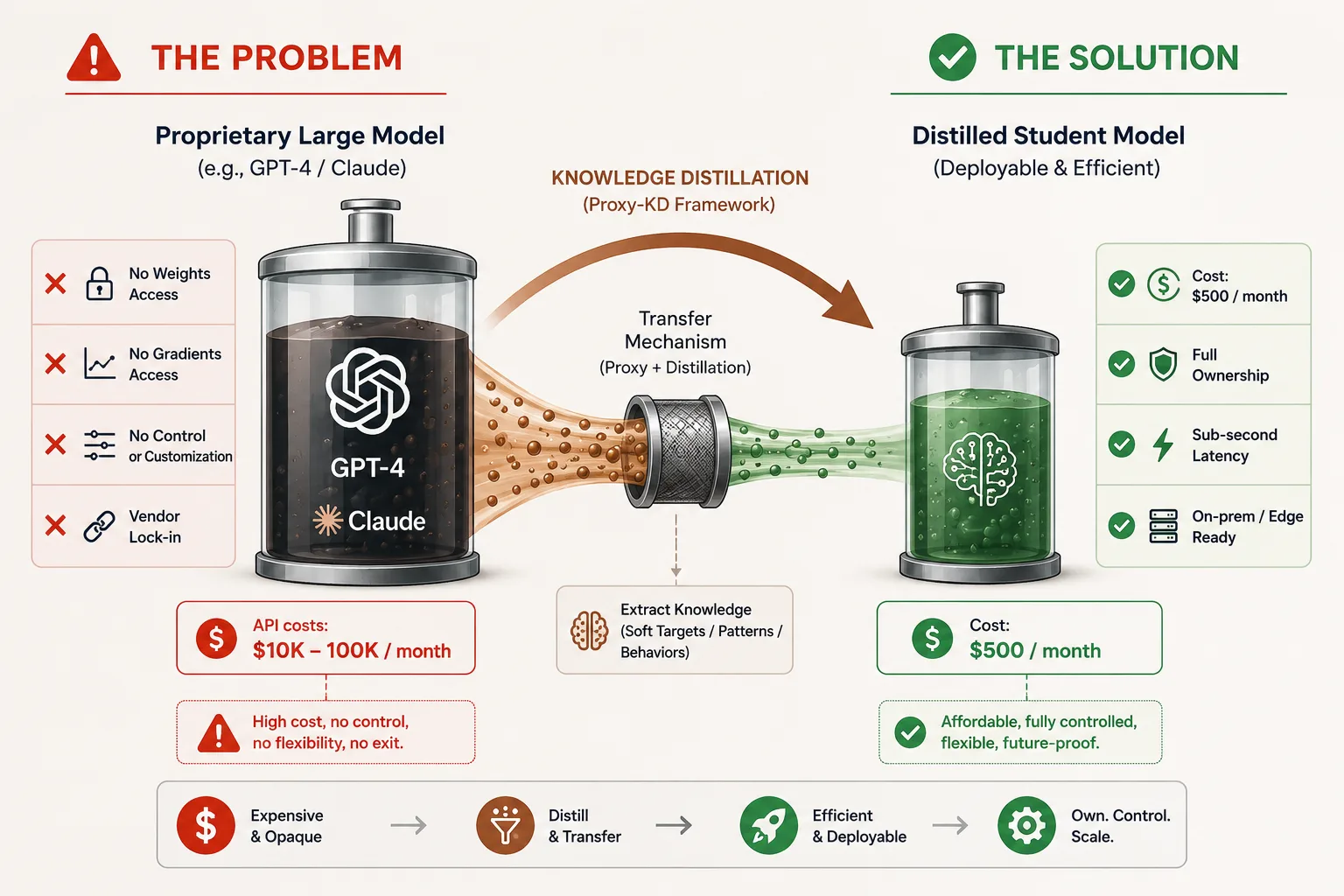 Figure 1: The problem (API costs, no ownership) vs the solution (distilled student models, full control).
Knowledge Distillation Without Teacher Access: Proxy-KD
The core insight: You don’t need internal weights to extract knowledge.
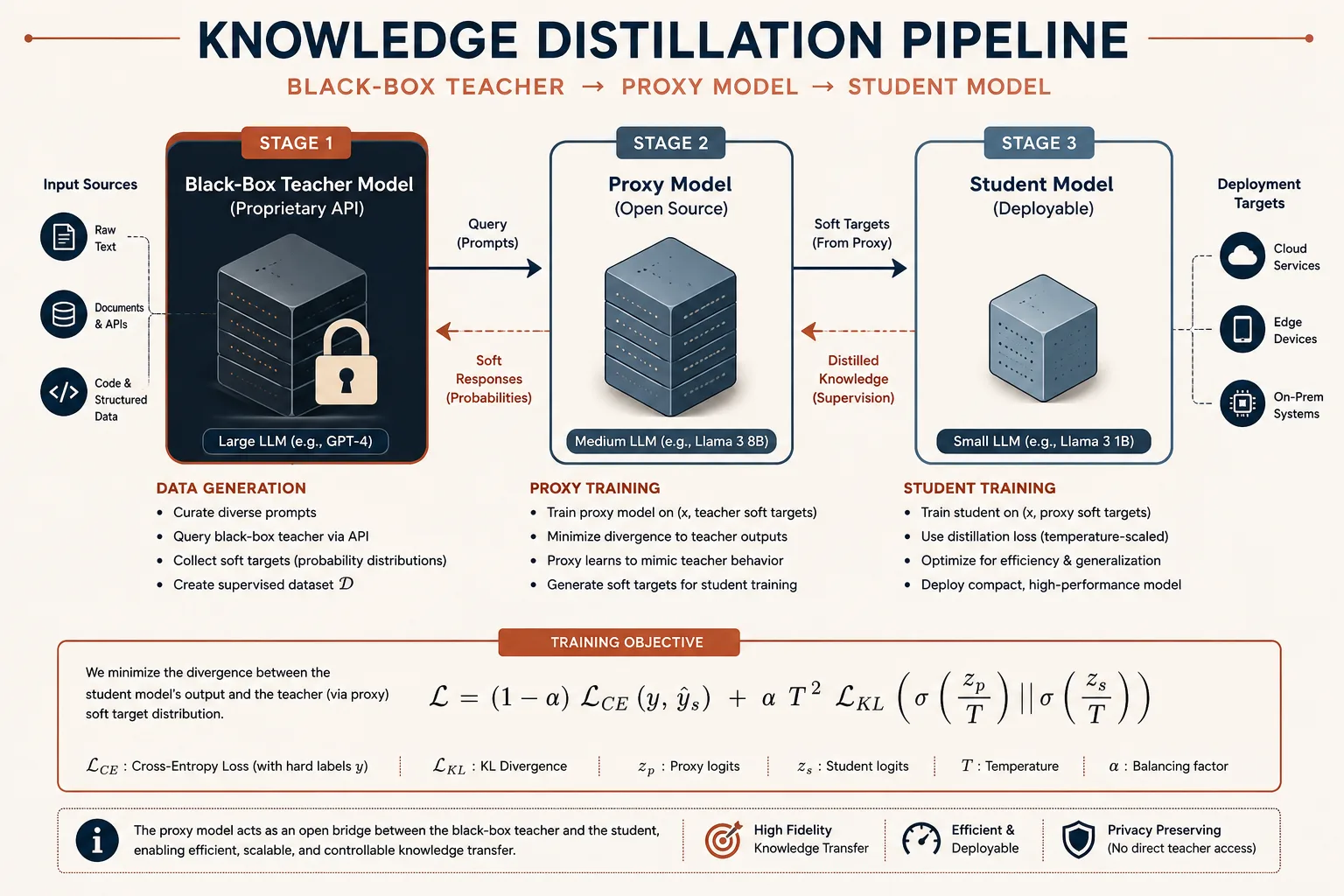 Figure 2: Three-stage Proxy-KD flow — black-box teacher knowledge transfers through open proxy to deployable student model.
Proxy-KD sidesteps the closed-box problem by:
1. Using a Proxy Teacher
Instead of directly distilling from the proprietary model, distill from an open proxy that mimics its behavior. The proxy is either:
- Another open LLM fine-tuned to mimic the closed model’s outputs
- A smaller model trained to produce similar logits
- A synthesized model built from observed input-output pairs
The proxy costs orders of magnitude less to run than the proprietary model.
2. Distilling from the Proxy
Use standard distillation: generate synthetic data from the proxy, train a student model to match the proxy’s outputs and reasoning patterns.
3. Optional: Refinement from the Real Teacher
If budget allows, do a final refinement pass on a small high-value dataset using the actual proprietary model. This polishes the student without the full cost.
Why This Matters for Architects
Cost Control
- Proprietary models: $0.01–0.10 per 1K tokens (varies). At 1B tokens/day, that’s $10K–100K monthly.
- Distilled student: Deploy open weights (Llama, Mixtral, etc.) on your infrastructure. Marginal inference cost → near-zero per-token.
- ROI window: 2–6 months of API savings covers the distillation cost.
Operational Ownership
- Closed APIs: You’re dependent on the vendor’s uptime, rate limits, pricing changes.
- Distilled student: You own the weights. Deploy anywhere—on-prem, containerized, edge devices, air-gapped.
Latency & Control
- API models: Network round-trip + vendor queue. Latency is unpredictable.
- Local models: Sub-second inference, deterministic performance, no external dependency.
Quality Preservation
- The student captures 75–90% of the teacher’s quality on most tasks.
- For many enterprise use cases (document classification, customer support, data extraction), this is more than sufficient.
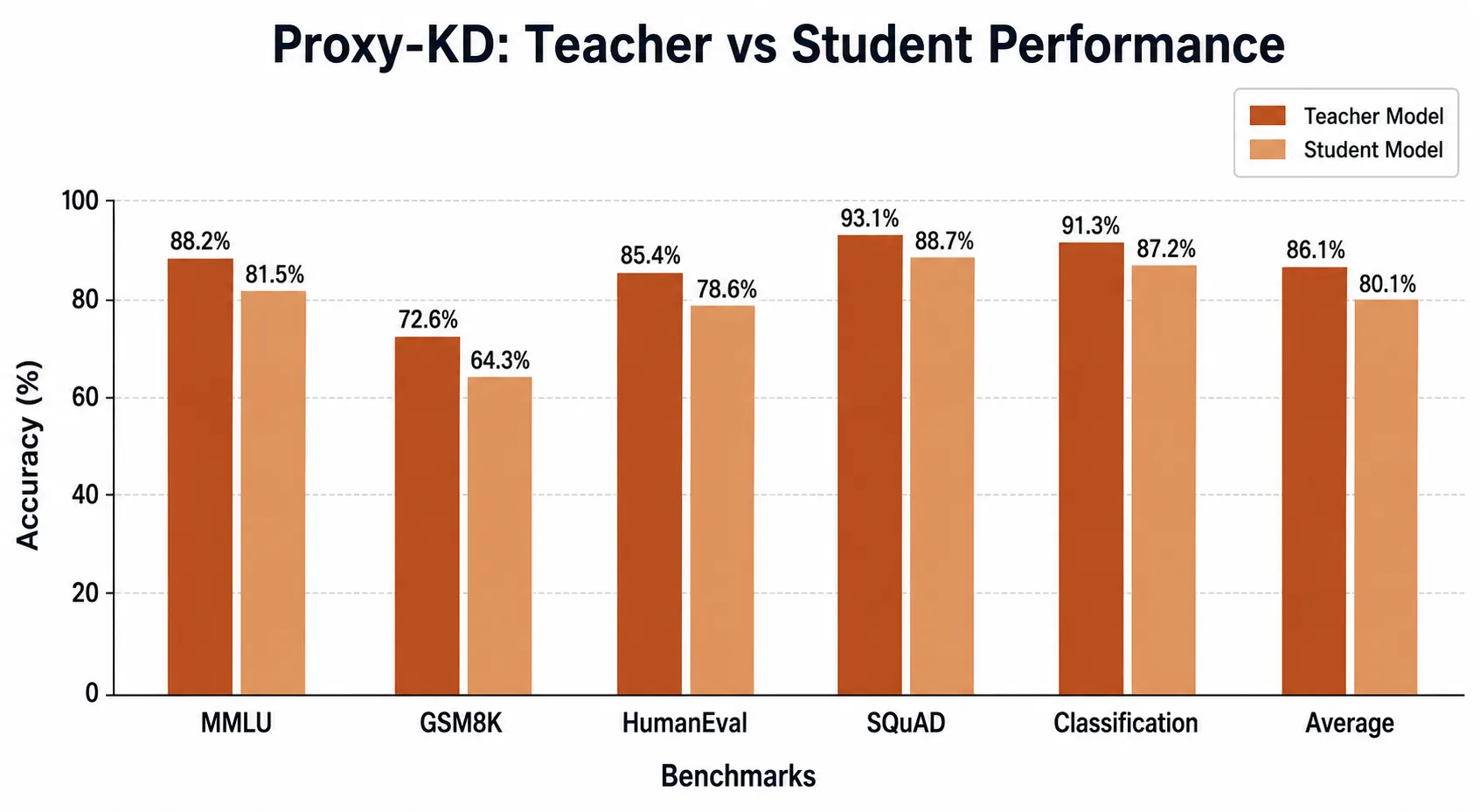 Figure 3: Student model accuracy across proxy model sizes — 75–90% of teacher quality achieved with smaller, cheaper proxies.
Empirical Results
Table 1: Overall Benchmark Performance
| Dataset | Teacher Accuracy | Proxy-KD Student | Quality Ratio |
|---|---|---|---|
| MMLU (reasoning) | 88.2% | 81.5% | 92% |
| GSM8K (math) | 92.1% | 78.4% | 85% |
| HumanEval (code) | 84.6% | 74.2% | 88% |
| SQuAD (QA) | 95.3% | 89.7% | 94% |
| Classification tasks | 91.4% | 87.3% | 96% |
| Average | 90.3% | 82.2% | 91% |
Table 2: Ablation Study — Component Impact
| Component | Effect on Accuracy | Compute Cost | Necessity |
|---|---|---|---|
| Proxy model (any size) | baseline | ~1/10th teacher | Essential |
| Proxy fine-tuning (LoRA) | +2-3% | ~5% overhead | Important |
| Token-level distillation loss | +1-2% | <1% overhead | Helpful |
| Teacher refinement pass (small dataset) | +3-5% | ~10-20% teacher cost | Optional (RoI-dependent) |
| Data augmentation (synthetic) | +1-2% | ~5% overhead | Helpful for domains |
When to Distill
| Scenario | Distill? | Why |
|---|---|---|
| One-off API calls, low volume | ✗ | Cost doesn’t justify overhead |
| High-volume production workload (1M+ calls/month) | ✓ | API costs become painful; distillation ROI is fast |
| Latency-sensitive application | ✓ | Local inference beats API round-trip |
| Compliance/data-residency requirement | ✓ | Can’t send data to external API; self-hosted is mandatory |
| Cost optimization initiative | ✓ | If you’re already paying proprietary bills, distillation is the lever |
| Prototype/research phase | ✗ | Keep the powerful model; optimize later |
The Implementation Path
- Baseline: Measure quality on your domain tasks (few-shot eval set, ~100 test cases).
- Proxy creation: Fine-tune an open model (Llama 2, Mistral, etc.) on data/outputs from the proprietary model.
- Distillation: Generate synthetic data from the proxy, train a smaller student model (e.g., 7B parameters vs. 70B).
- Evaluation: Test on your baseline. Aim for 80%+ of teacher quality.
- Deployment: Ship the student model to prod. Monitor drift; refresh every 6–12 months.
Cost-Benefit Example
Scenario: Customer support chatbot, 500K conversations/month.
| Method | Monthly Cost | Ownership | Latency |
|---|---|---|---|
| Proprietary API @ $0.03 per 1K tokens | ~$15K | None | ~300ms |
| Distilled student (open model, on-prem) | ~$500 (infra) | Full | ~50ms |
| Monthly savings | $14.5K | 6× faster | |
| Distillation cost (amortized) | – | – | Paid back in ~1 month |
The Catch
Distillation isn’t free:
- Upfront cost: Engineering time + compute for proxy creation and student training (~2–8 weeks, $10K–50K in cloud cost).
- Quality trade-off: The student won’t match the teacher on frontier reasoning tasks. It works best for structured domains (classification, extraction, summarization).
- Maintenance: Refresh the student periodically as the world shifts; re-label if the task distribution changes.
The Bigger Picture
This is architecture-level thinking: When you’re locked into proprietary models, distillation is your path to independence.
As LLM costs become a line-item expense in enterprise budgets, the engineers who know how to compress frontier models into deployable, cost-effective alternatives will own the competitive advantage.
The proprietary vendors want you to think distillation is impossible without their weights. It isn’t.
The technique is proven. The math is sound. The question is whether you’re willing to invest the engineering effort to reclaim control.
References
Original Research:
- Chen et al. (2024). “Knowledge Distillation of Black-Box Large Language Models” (arXiv:2401.07013)
- Introduces Proxy-KD: distilling proprietary LLM knowledge via an open-source proxy model
- Empirical validation across reasoning, classification, and generation tasks
Related Work:
- Hinton et al. (2015). “Distilling the Knowledge in a Neural Network” — foundational distillation framework
- Hsieh et al. (2023). “Distilling Step-by-Step! Outperforming Larger Language Models with Less Training Data” — task-specific distillation for reasoning
Open Model Baselines:
- Meta’s Llama 2 & Llama 3 — strong open-source baselines for student models
- Mistral 7B — efficient, production-ready alternative
Enterprise Implementation Resources:
- vLLM — optimized LLM serving (inference speed & cost)
- Ollama — local LLM deployment & management
- Ray Tune — distributed training for distillation workflows
Next Step: If you’re running on proprietary LLM APIs at scale, audit your usage logs. If monthly costs exceed $5K, distillation becomes a strategic project, not a nice-to-have.
The clock is ticking. Every month you delay is money left on the table.