Hermes vs OpenClaw: Why I Split My AI Agents Into a Delivery Plane and an Execution Plane
One agent that schedules, executes and messages you is one you cannot debug. Split agents by capability and the symptom names the broken part.

Split AI agents by capability, not by task name. One plane delivers: it owns the schedule and the only channel to you. Other planes execute, fetch, run long sessions or retrieve knowledge, and none of them speak to you directly. When each plane owns one capability, the shape of a failure tells you which part broke.
Hermes vs OpenClaw: Delivery vs Execution
I run a small fleet of AI agents on one shared memory. Two of them, Hermes and OpenClaw, used to get confused for each other all the time. On the surface both “do things automatically”. They are not the same. One delivers. One executes. Mixing them up is how an agent system turns into a tangle nobody is able to reason about.
When I first wrote this down there were three planes. There are now five, and fetching a web page no longer belongs to OpenClaw. The design did not get more complicated because I wanted more tools. It grew because each new capability got its own owner instead of being bolted onto an agent that already existed.
That is the real subject of this post: split agents by capability, not by task name.
The rule underneath everything
Every plane owns exactly one capability. When a job arrives, the question is not “which agent handles this kind of task?” It is “what does this work physically need?”
A task’s name tells you nothing. Its required capability tells you everything. “Who handles social publishing?” has no answer by name. By capability it is obvious: the plane that reaches me decides, the plane that holds credentials and outbound reach publishes, and a scheduled check verifies.
Here is the current shape.
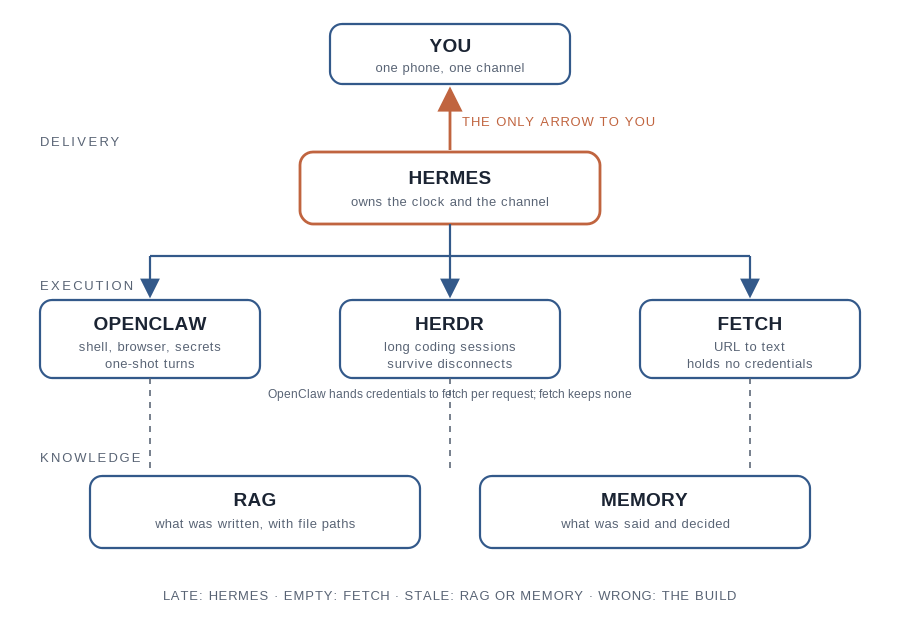
Hermes: the clock and the channel
Hermes answers two questions: when does something run, and how does it reach me.
- Scheduler. Anything recurring is a Hermes cron entry. It does not matter which plane does the work. Hermes decides when.
- Telegram, and only Telegram. This is a hard rule: Telegram out is Hermes only. No other plane posts to my phone. They hand Hermes the finished payload and Hermes delivers it.
Why so strict? One delivery channel means one place to debug a missing message, one rate limiter, one formatting layer. Let three agents message you and you have three silent failure modes.
Hermes has grown one responsibility since the first version: it owns scheduling writes. Queue files, publish status and publish intents are Hermes territory. That fits the same capability. Deciding when something goes out includes recording that decision.
OpenClaw: the hands
OpenClaw is the privileged executor. It runs shell commands and reads and writes files. It drives a browser through flows that need clicking, such as a multi-step login. It holds access to the password manager. Credentials live behind it, not scattered across planes.
It deliberately has no voice. When OpenClaw has something to say, it hands it to Hermes.
It also works in short turns. An OpenClaw call is one shot with a timeout. That limit turned out to matter more than I expected, and it is why the next plane exists.
What moved: fetch got its own owner
The original version of this post said OpenClaw fetches the data behind my daily digest. That stopped being true on 2026-08-20.
Turning a URL into text now belongs to a dedicated fetch service. It renders JavaScript in a real browser and returns markdown, HTML, a PDF or a screenshot. It holds no credentials. When a page needs me to be logged in, OpenClaw supplies the cookies for that one request, and the fetch service keeps none afterwards.
Two lessons came out of that move, and both are about honesty rather than speed:
- A login wall looks like success. The raw fetch API returned a success flag with the sign-in page as the content. An agent reading that would summarise the login screen and report a job well done. The wrapper every plane now goes through raises an error instead.
- Cookies leak between crawls. Pooled browser sessions replayed injected cookies onto later requests to the same site. A crawl believed to be anonymous ran as me. The wrapper flushes them after each call.
So OpenClaw kept the part that needs privilege and interaction. The part that only needs “give me the text of this page” went to a service with less power. That is the capability rule applied to a plane I already had.
The other three planes
herdr runs long coding sessions. It manages terminal panes where coding agents work for twenty minutes or more, and those sessions survive the caller disconnecting and the box rebooting. OpenClaw’s short turns cannot do that, and herdr should not do one-shot work, because spinning up a session to run one command is expensive and leaves state behind. Agents cannot reconfigure it either. The bridge that exposes it refuses those verbs on purpose.
RAG answers “what is written about X”. It indexes the notes and code, returns matching passages with file paths, and writes nothing. It is a snapshot, so it is never the authority for anything time-sensitive.
Memory answers “what did we say or decide about X”. It stores past conversations, summaries and decisions. It is also not current state: a decision recorded in March might have been reversed since.
The split between those last two matters more than the names suggest. Retrieval over what was written and recall of what was said sound interchangeable. Asking the wrong one gives a confidently wrong answer, or silence that reads as “nothing found”.
The symptom names the owner
This is the payoff. Because each plane owns one capability, triage is a lookup instead of an investigation.
| Symptom | Where to look | Because |
|---|---|---|
| Late | Hermes | it owns the clock and the channel |
| Empty | the fetch service | it owns turning a URL into text |
| Empty, but it is a login page | the session cookies | the fetcher did its job on the wrong page |
| Wrong | the build | logic, not delivery |
| Stale | RAG or memory | an index or a sync is lagging |
| Up but useless | the service itself | being alive is not being correct |
A real case: my knowledge index stopped accepting writes for about two days. A credential rotation reached one container and not the other. The answers kept coming back, just older than they looked. The symptom was “stale”, so the owner was the index, and that is where the fault was. The fast refresh path had failed twice in that window and recorded nothing. The nightly job reported its failure to a central run log, and that report is the only reason anyone found it. A plane with one job, and a job that reports its result, made a silent failure findable.
Before routing: does it need an agent at all?
The capability rule has a gate in front of it. If the work has exactly one correct answer, it does not get an agent. It gets a script on a schedule.
The daily digest taught me this. The first version had Hermes ask OpenClaw to fetch feeds on a schedule. The agent call kept timing out, and no digest arrived for days. It was replaced with a deterministic script that fetches and ranks, followed by a model call that only writes the summary, delivered through Hermes. Nothing about that job needed judgement until the final paragraph.
The same pattern shows up across the whole setup. Of 98 custom agent definitions, 85 have never been invoked. Around fifty scheduled jobs produce real output every day. The working agent company was always the cron fleet. Agents earn their place only where the right output is not knowable in advance.
Security falls out of the split
Separating planes by capability is also least privilege, almost for free.
- Secrets live in one plane. OpenClaw holds password manager access. Hermes, which talks to me, never needs it.
- The fetch service is credential-free. It receives cookies per request and keeps nothing, so compromising it does not hand over an account.
- The tool bridge is deliberately poor. The sidecar that exposes retrieval and session tools to the agents holds no secrets, no shell and no access to the container runtime. Its whole surface is calls to services that enforce their own limits.
- Nothing publishes without the gate. Whichever plane triggers a post, the bytes go out through a publisher that runs a confidentiality denylist first. Write access is not permission to reach a public feed unscanned.
- Capability is not ownership. Hermes and OpenClaw can both write files now. Ownership is still split by file class, so a wrong file has one owner to ask, not two suspects.
One gap is still open, and I would rather name it than hide it. Nothing cryptographically binds an action to the plane that took it. Today “which plane did this” is rebuilt from logs that any plane could have written. That is a forensics inconvenience now, and it becomes a real problem the day a plane misbehaves.
When to reach for which
- Sending or scheduling: Hermes.
- Privileged, short, interactive, or secret-bearing: OpenClaw.
- Plain page to text: the fetch service.
- Long-running coding work: herdr.
- What is written: RAG. What was said: memory.
- One correct answer: none of the above. Write a script.
The takeaway
People build one mega-agent that schedules, executes, reaches, remembers and notifies, and then cannot tell why it broke. The lesson is not “use these tools”. It is the shape: separate the plane that acts from the plane that announces, and give every other capability exactly one owner.
Hermes is the mouth. OpenClaw is the hands. The others fetch, persist and remember. None of them does another’s job, and when something breaks, the symptom already knows whose door to knock on.
Building agents is the easy part. Keeping them legible six months later is the job, and that comes from the boundaries, not the models.