You can't predict when quantum breaks your encryption. You can be ready for it.
A practical plan for a financial-services CTO: why post-quantum work starts now, what breaks in production when you migrate, what SEBI's CSCRF expects you to show, how to phase the cost, and what to do in the first 90 days.

Start with an inventory of where cryptography lives, because SEBI's CSCRF already requires it. Move key exchange first, using hybrid X25519MLKEM768 behind a fallback, since stolen traffic is the risk today. Test middleboxes for the larger handshake, phase signatures and HSM changes later, and isolate what cannot move.
I was in an architecture discussion with a SEBI-regulated institution about redesigning one of its core systems. I proposed that the new design be ready to accept quantum-safe encryption standards and start replacing the existing ones, and I set out the likely effect on cost and an adoption plan next to it. This article is that proposal, without the client’s details.
A CTO’s fair objection is that no quantum computer today can break anything, so why spend on it now? This piece answers that in one section, then spends the rest on the questions that come next: what breaks when you migrate a live system, what the regulator expects to see, what it costs, and where to start.
| Question | Short answer |
|---|---|
| Why now? | Traffic stolen today can be decrypted later, and the migration takes years. |
| What breaks? | Bigger handshakes trip old middleboxes; bigger signatures break fixed-size fields; HSMs, partners and old runtimes lag. |
| What does SEBI expect? | CSCRF Box Item 7: a cryptographic inventory, a migration strategy, policy, skills and proof-of-concept trials. |
| What does it cost? | Mostly discovery and testing, not algorithms. Phase it: key exchange first, signatures later. |
| Where to start? | A 90-day plan: inventory, classification, one hybrid proof of concept. |
Why this cannot wait
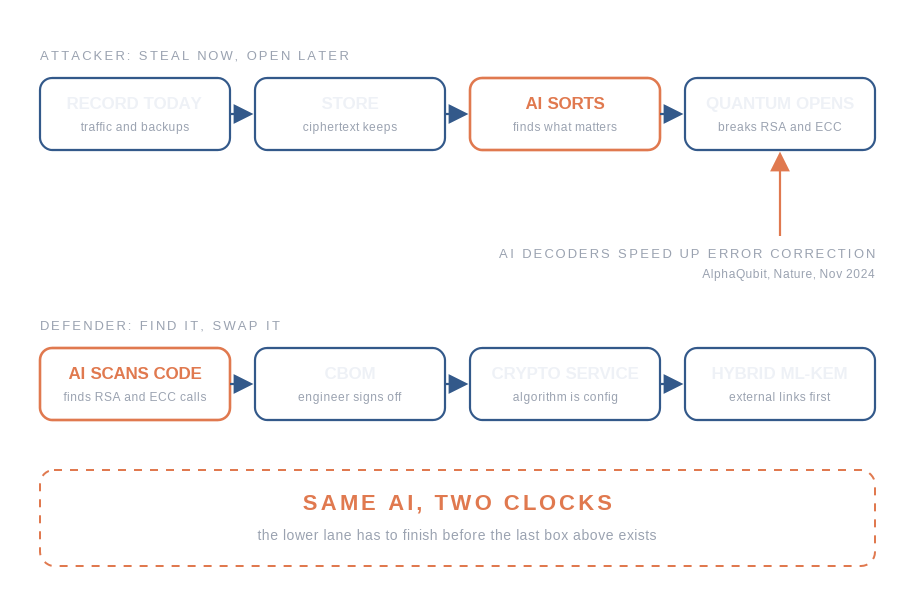
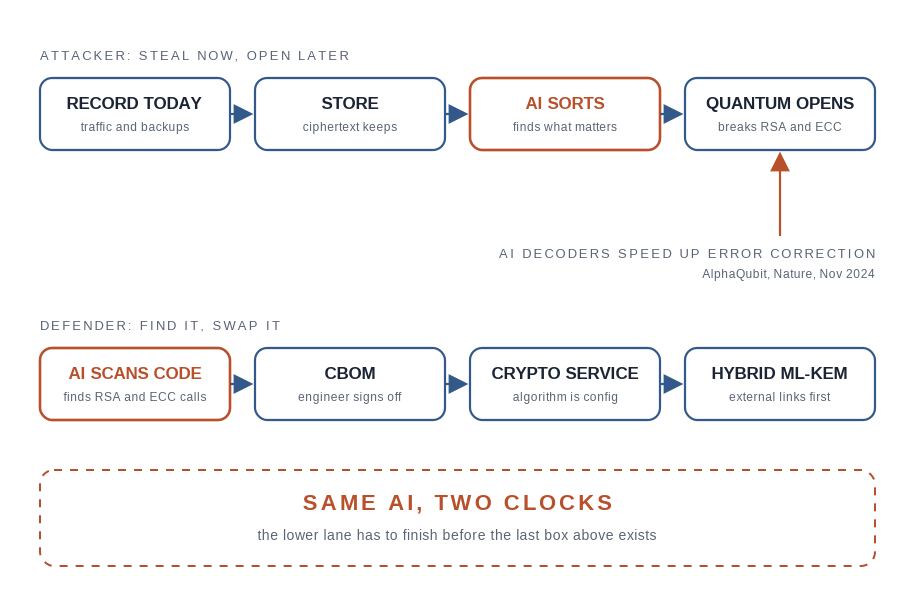
An attacker can record your encrypted traffic or copy an encrypted backup today and keep it until a large enough quantum computer runs Shor’s algorithm against RSA and elliptic curve cryptography. This is harvest now, decrypt later. The risk started on the day the data was copied, so anything that must stay secret for years (client identity records, trade and position history, settlement data, long-lived credentials) is already exposed.
AI cannot break encryption, but it makes the stealing cheaper. In November 2025 Anthropic reported that a group it assessed as Chinese state-sponsored had used its Claude Code tool to run 80 to 90% of an espionage campaign against about 30 organisations, financial institutions among them. The attack succeeded in a small number of cases. Anthropic says the model occasionally hallucinated credentials, so a human had to check its work, and some researchers have questioned how autonomous it really was. My own reading, not a published result: language models also make it cheap to sort terabytes of stolen data later, so attackers no longer need to choose carefully what to take.
The machine is getting closer on paper. In November 2024 Google DeepMind and Google Quantum AI published AlphaQubit in Nature, a transformer-based decoder that made 6% fewer errors than tensor network methods and 30% fewer than correlated matching on Google’s Sycamore processor. In May 2025 Craig Gidney of Google Quantum AI estimated that 2048-bit RSA could be factored in under a week with under a million noisy qubits; his 2019 estimate with Ekerå needed 20 million. Nobody has either machine, and nobody can predict the year one arrives, but the qubit count on paper fell about 20 times in six years. That uncertainty is the point: a migration that takes years has to start before the date is known.
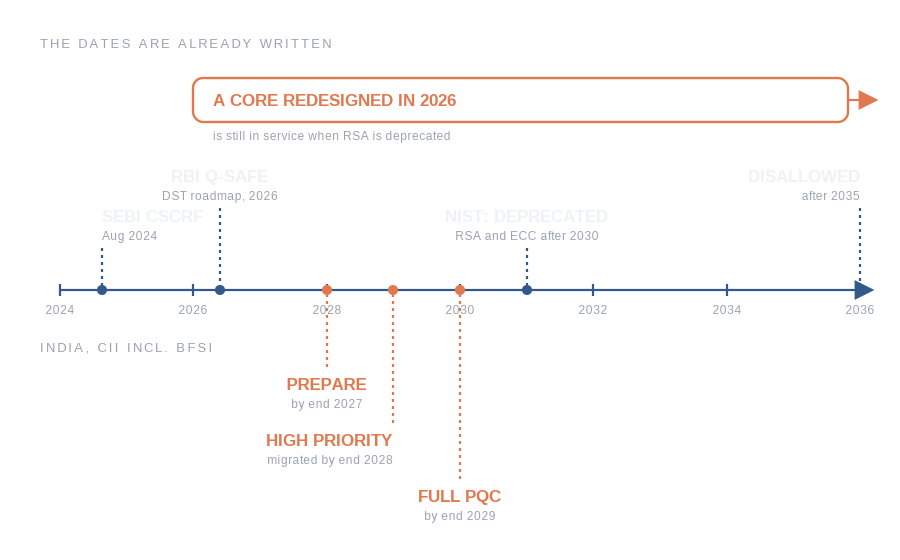
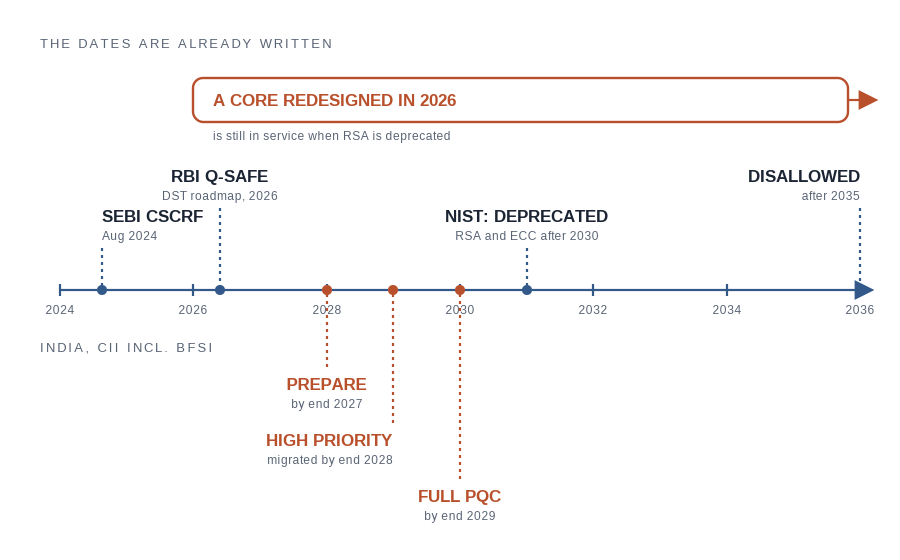
The dates are written down. India’s Department of Science and Technology published its final roadmap under the National Quantum Mission in May 2026, after a task force report in February. For critical information infrastructure (defence, power, telecom and other critical sectors, which in India include banking and finance) it sets three dates: preparation by 31 December 2027, high-priority systems migrated by 31 December 2028, and full post-quantum cryptography by 31 December 2029. Other enterprises get until 2028, 2030 and 2033. The roadmap says it is “not itself a regulatory mandate”; enforcement is left to sector regulators.
RBI set up its Q-SAFE expert committee on 25 May 2026 to recommend a roadmap for quantum-securing the Indian financial system. NIST’s final transition plan (IR 8547, October 2026) deprecates RSA and ECC at every security strength after 2030 and disallows them after 2035. A system redesigned this year will still be running in 2030.
What breaks when you migrate a live system
The new algorithms are not slow. They are big, and size is what breaks production.
Handshakes get larger. The hybrid key exchange browsers now use, X25519MLKEM768, sends a 1,216-byte key share where X25519 alone sends 32 bytes. That pushes the TLS ClientHello past a single network packet. Some legacy servers and middleboxes fail on that: when Cloudflare sent the post-quantum key share first, about 0.34% of the origin servers it scanned failed to complete the handshake. Outside those failures, measured latency impact is negligible. In a bank the suspects are load balancers, WAFs, SSL inspection appliances and old partner gateways.
Signatures get much larger. An ML-DSA-65 signature (NIST FIPS 204) is 3,309 bytes; an ECDSA P-256 signature is about 64. Anything sized for the old signature breaks: certificate chains, signed messages, database columns, message formats with fixed-length fields, and partner APIs that validate payload size.
Runtimes and HSMs lag. OpenSSL 3.5 (April 2025, a long-term support release) ships ML-KEM, ML-DSA and SLH-DSA and prefers the hybrid key exchange by default. Java added ML-KEM and ML-DSA in JDK 24 (March 2025), and Oracle has published plans to bring them to older long-term support releases. Older stacks need an upgrade or a library such as Bouncy Castle. HSM support depends on the vendor and the firmware version, so it has to be checked model by model.
Counterparties are not ready. Cloudflare reports that 12.8% of the origin servers it scans support post-quantum key exchange. Most of your partners will not negotiate it yet. Hybrid exchange falls back to classical when the other side cannot, which is why it is the safe way to start.
Two rules keep production safe. Move key exchange first and signatures later: harvest now, decrypt later is a threat to key exchange today, while a forged signature needs the quantum computer to exist at the moment of the attack. And put every change behind a per-link switch with a classical fallback, so a failing middlebox costs a configuration change, not an outage.
What SEBI’s CSCRF expects you to show
SEBI’s Cybersecurity and Cyber Resilience Framework (CSCRF), issued on 20 August 2024, requires periodic risk assessment “including post-quantum risks”. Box Item 7 lists four measures regulated entities “shall” focus on. This is the evidence I would keep ready for each:
| CSCRF Box Item 7 measure | Evidence to keep |
|---|---|
| “maintain an inventory of cryptographic assets, prioritizing critical assets for Post Quantum Cryptography (PQC) migration, and assess their IT infrastructure capabilities” | A cryptographic bill of materials (CBOM) tagged by criticality, plus a capability check of HSMs, runtimes, libraries and network devices |
| “develop strategies for the protection of assets which can and cannot be migrated to PQC” | A migration plan, and for what cannot move, isolation and compensating controls with a named risk owner |
| “upgrade employees’ skills, periodically revise policies and conduct proof-of-concept trials” | A training record, a revised cryptography policy and a proof-of-concept report |
| “explore the feasibility to adopt PQC and technologies like Quantum Key Distribution (QKD)” | A short feasibility note with a decision and its reasons |
CSCRF does not set a date by which algorithms must change. It asks you to know where you stand and to have a plan, and it names harvest now, decrypt later as the attack it is worried about.
What it costs, and how to phase it
I will not put a rupee figure on this without seeing an estate. The cost drivers are predictable, though, and the algorithms are the cheap part:
- Discovery: how many applications, integrations and certificates you run, and how much of the code nobody on the current team wrote.
- Testing: every middlebox, partner link and fixed-size field the larger keys and signatures pass through.
- Hardware and vendors: HSM firmware or replacement, and vendor products that hold keys.
- Coordination: partners and counterparties who have to move with you.
AI lowers the first driver most. AI coding tools can read a codebase faster than any team, flag every RSA and ECC call, hardcoded key size and certificate reference, and draft the CBOM that CERT-In’s 2025 technical guidelines also recommend. They find candidates; an engineer still confirms each one. Keys inside an HSM or a vendor’s binary will not show up in source, so the inventory still needs the vendor list and the HSM configuration next to it.
The phasing I would use follows the national milestones:
- By end 2027, prepare: CBOM, data classified by how many years it must stay secret, one internal crypto service so algorithms become configuration, vendor contract terms that ask for a post-quantum roadmap and a CBOM.
- By end 2028, move key exchange: hybrid ML-KEM (NIST FIPS 203, published August 2024) on external links carrying the longest-lived data first, then internal links.
- By end 2029, move signatures and the rest: certificates, signed messages, HSMs. Isolate what cannot move, as CSCRF asks.
If a core redesign is already under way, fold phase 1 into it. Retrofitting crypto agility into a live core means touching every integration twice; designing it in means touching each one once, while the team is already in the code.
Where to start on Monday: the first 90 days
Days 1 to 30. Name one owner. Start with the critical systems list your board already approves under CSCRF. Run AI-assisted discovery on those systems, pull the HSM and vendor list, and draft the CBOM.
Days 31 to 60. Classify the data in those systems by shelf life. Add post-quantum risk to the risk register. Ask each key-holding vendor in writing for its post-quantum roadmap. Choose the crypto agility pattern for new code.
Days 61 to 90. Run one proof of concept: hybrid X25519MLKEM768 on one external, non-critical link, behind a switch with a classical fallback. Measure handshake failures and latency through your own load balancers and WAFs. Then take a phased plan and the CSCRF evidence table to the board.
Get the full blueprint
The Quantum readiness blueprint (PDF, 12 pages) turns this article into tools you can hand to a team: the six phases mapped to SEBI CSCRF and the DST milestones, a scoring method to decide what moves first, the 90-day checklist, a CBOM worksheet built on CERT-In’s fields, the production-break checklist, the CSCRF evidence pack, ten vendor questions and a board paper outline. It builds on public work from the G7 Cyber Expert Group, Europol’s Quantum Safe Financial Forum, Canada’s Quantum-Readiness Working Group and the UK NCSC, adapted for India. It is free: confirm your email and the download opens straight away, along with the newsletter.
FAQ
Why do organisations need quantum readiness before quantum computers exist?
Encrypted data stolen today can be decrypted once a large quantum computer exists. Data that must stay secret for years is already exposed. Migration also takes years.
Does SEBI require post-quantum cryptography today?
CSCRF requires a cryptographic inventory, post-quantum risk assessment and a migration strategy. It does not set a date by which algorithms must change.
Will post-quantum cryptography slow down our systems?
Measured latency impact of hybrid key exchange is negligible. The risk is size. Larger handshakes can break old middleboxes, and larger signatures can break fixed-size fields.
Can AI break RSA encryption?
No. Breaking RSA needs a large fault-tolerant quantum computer running Shor’s algorithm. AI helps build such machines and helps attackers steal and sort data.
Ask your team one question this week: where in our estate does RSA live? If the answer takes more than a day, you have found your first CSCRF gap.